
Imagine telling a teenager that people were once paid to wake workers up by tapping on their bedroom windows with long sticks.
Or that entire industries employed thousands of people to manually connect telephone calls, deliver telegrams, light street lamps and perform calculations before computers existed.
According to new research from AnyBusiness.com.au, many once-common professions have disappeared almost entirely as technology transformed the way people communicate, work and access information.
The findings offer a fascinating glimpse into how quickly the labour market can evolve and what today’s businesses can learn from the careers that vanished.
15 Jobs That Have Almost Completely Disappeared
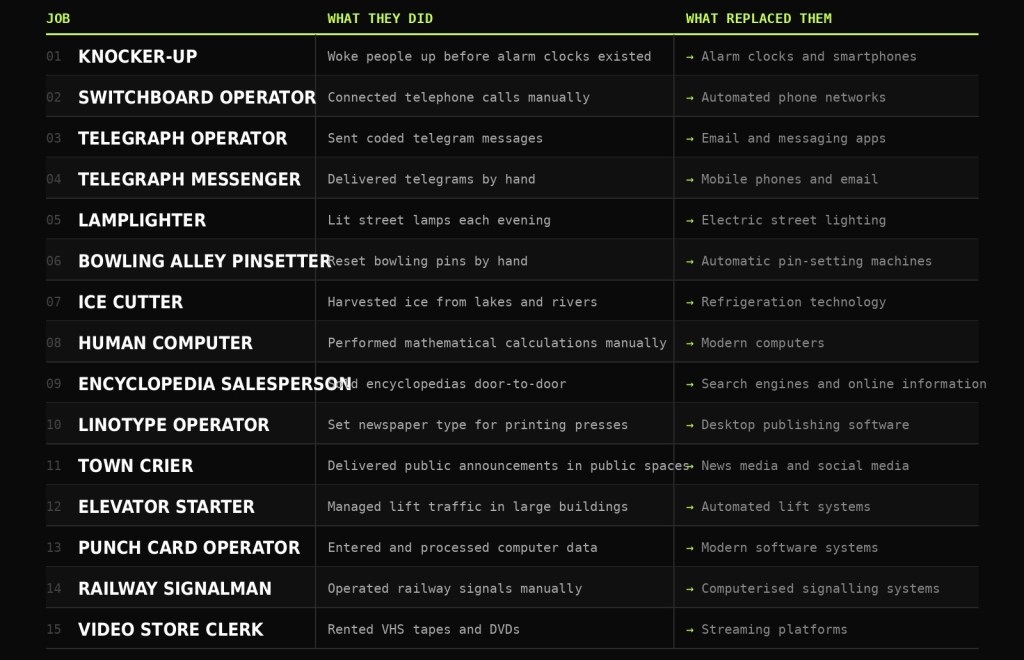
Technology Changed the Delivery, Not the Need
According to Mary Tamvakologos, Director of Operations at AnyBusiness.com.au, the disappearance of these professions highlights a common pattern throughout history.
“Most people assume the jobs around them will always exist because they are familiar. History shows that is rarely the case.”
She notes that many of these careers were once viewed as stable and respected professions, with entire industries and training programmes built around them.
“What changed wasn’t necessarily the underlying customer need. People still wanted information, entertainment, communication and convenience. Technology simply created faster and more efficient ways to deliver them.”
Some Industries Disappeared Almost Overnight
While some professions faded gradually over decades, others were wiped out surprisingly quickly.
The rise of streaming services dramatically reduced demand for video rental stores. Search engines largely replaced printed encyclopedias. Smartphones combined the functionality of alarm clocks, calculators, cameras, maps, music players and numerous other standalone products into a single device.
As consumer habits shifted, many businesses found themselves unable to adapt fast enough.
A Lesson for Modern Businesses
The research also offers a warning for today’s business leaders.
According to Tamvakologos, one of the biggest mistakes organisations make is assuming customer behaviour will remain unchanged.
“The companies that survive major shifts are usually the ones paying attention to how consumer habits are changing before those changes become obvious.”
She encourages business owners to regularly challenge their assumptions by asking a simple question:
“If this business was launched for the first time today, would it look the same?”
If the answer is no, there may be opportunities to innovate before competitors do.
The Future of Work Will Keep Evolving
The disappearance of professions such as knocker-ups, human computers and telegraph operators serves as a reminder that no industry remains static forever.
As artificial intelligence, automation and digital technologies continue to reshape the economy, today’s most familiar jobs could eventually join the growing list of careers that future generations struggle to believe ever existed.
For businesses and workers alike, adaptability remains one of the most valuable skills of all.

